Learn how to verify therapist credentials step by step. Check licenses, confirm status, and use state board lookups to find a qualified therapist.

How to Verify Therapist Credentials: 7-Step Guide
read more

Learn how to verify therapist credentials step by step. Check licenses, confirm status, and use state board lookups to find a qualified therapist.

Learn practical strategies for managing anxiety after physical injury, from breathing exercises to therapy, and rebuild confidence in your recovery.
Have a free discovery call to talk with one of our therapists.
Last Updated: October 18, 2026
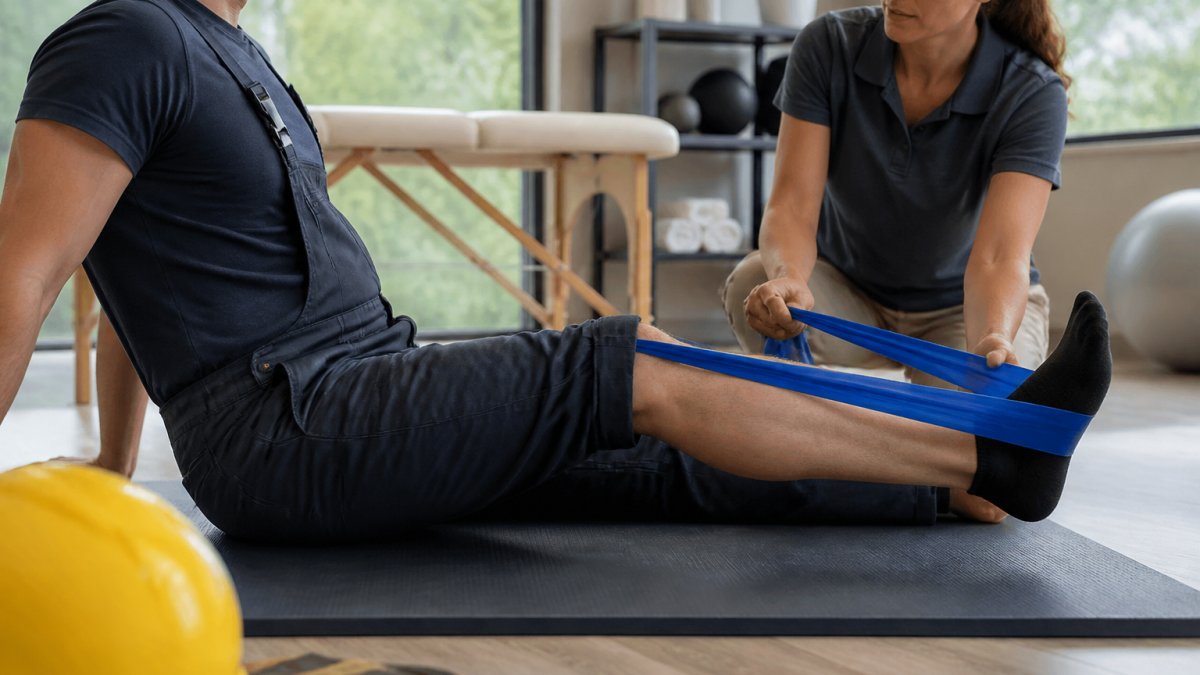
Workplace injury recovery works best when you treat exercise like a prescription, not a workout. At Elite Therapy Solutions, our fellowship-trained doctors of physical therapy start every plan with a simple rule: the right movement, at the right dose, at the right time. Skip that order and you risk a setback. (Source: Occupational Safety and Health Administration’s (OSHA) guidance on musculoskeletal disorders)
Before your first rep, line up four things:
The Occupational Safety and Health Administration tracks work-related musculoskeletal injuries closely, and its guidance makes one point clear: recovery is a gradual process, not a sprint.
One more thing. Movement modification matters more than motivation. A sore back does not need heroics. It needs consistency.
Gentle stretching after a workplace injury is the first active step, and it should feel easy, not intense. The goal is circulation and joint mobility, not a deep stretch. Hold each position for 15 to 30 seconds and breathe normally.
Start with these:
Do this once or twice a day in the first week. Keep the range small. If a stretch causes sharp pain, back off and try a smaller version tomorrow.
Stretching is not a warm-up for strength work yet. It is a check-in. You are teaching the tissue that movement is safe again.
Back pain is the most common work-related complaint we treat, and the exercises for it are surprisingly gentle. Work injury recovery exercises for back pain focus on the deep core, hips, and glutes, the muscles that protect the spine during lifting and sitting.
A common clinician-guided progression moves through three phases. Early on, the goal is gentle mobility and pain control. Next comes controlled strengthening of the core and hips. Last is job-specific loading, such as lifting and carrying. You only advance when the current phase feels comfortable and your symptoms are stable, not on a calendar date.
Try this starter set, three to five reps each, only after your clinician confirms it fits your injury:
A common mistake is chasing a big range of motion too early. Small, controlled reps build work tolerance faster than sloppy big ones. Another mistake is adding load before the movement pattern is clean. If your back rounds or your hips shift during a bridge, you are not ready to add resistance.
Use a simple stop rule. Stop the exercise and contact your clinician if you feel sharp pain, pain that travels down a leg, numbness or tingling, or new weakness. Mild soreness that fades within a day is usually a sign to scale back the reps or range, not to quit. Worsening pain over several sessions is a signal to get reassessed rather than push through.
Strength and conditioning come next, once gentle movement feels comfortable. This stage builds the load tolerance your job demands. Add low-impact aerobic activity like walking or aquatic exercise to support circulation without jarring sore joints.
Build in this order:
Increase one variable at a time. Add a few reps, or a few minutes, but not both in the same week. That is how you avoid reinjury.
Plyometric exercise, like jumping and lateral hops, belongs at the very end of recovery, and only with clinician clearance. It loads tissue hard and fast.
Return-to-work exercises after injury rebuild the exact movements your job requires. This is called work conditioning or work hardening, and it is where recovery meets real life.

A staged plan works better than a random list of drills. A common clinician-guided sequence looks like this:
Match the drill to the job:
Functional training should mirror your job-specific movements. If you lift boxes at work, practice lifting boxes, not just dumbbells. If you climb ladders, practice stepping and reaching at height with supervision.
Measure readiness rather than guessing. Track how many minutes you can tolerate the job task, how much load you can handle with good form, and whether symptoms stay stable during and after the drill. Bring those notes to your clinician. Functional capacity testing and clinician assessment, not exercise alone, guide return-to-work decisions and any work restrictions.
Ergonomics matter here too. Adjust your chair height, screen position, and workstation layout before you return. Small changes prevent the same injury from returning. Pair those changes with task modification, proper lifting technique, and scheduled breaks so the factors that aggravated the injury are addressed alongside your exercise plan.
Most people should do physical therapy exercises after an injury two to three times per day for gentle mobility work, and three to four times per week for strengthening. Your clinician sets the exact schedule based on your injury and stage of recovery.
Frequency beats duration. Short, frequent sessions keep tissue moving without overloading it.
Track your progress with simple measures:
| What to Track | How to Measure | Why It Matters |
|---|---|---|
| Pain level | Rate 0-10 before and after | Shows whether the dose is right |
| Range of motion | Note how far you can bend or reach | Tracks joint mobility gains |
| Endurance | Minutes you can sit, stand, or walk | Builds work tolerance |
| Strength | Reps completed with good form | Guides load progression |
Bring these notes to your appointments. They help your therapist adjust your treatment plan and measure functional capacity over time.
Stop exercising and call your clinician if you feel sharp pain, numbness, tingling, dizziness, or new swelling. These are clear safety signals, not signs of weakness. Ignoring them is how minor strains become serious setbacks.
Scale back, rather than stop, when soreness is mild and fades within a day. Drop the reps or range and keep moving gently.
Call your clinician promptly if:
That last point matters. Fear of reinjury is real, and it slows recovery. A good care team addresses the mental side, not just the physical exercises.
Recovering from a workplace injury takes patience, the right exercise dose, and a plan built around your job. Guessing at it, or pushing through pain, usually costs more time than it saves.
Elite Therapy Solutions builds personalized programs around your injury, your work demands, and your recovery goals. Our fellowship-trained doctors of physical therapy offer individualized care, direct collaboration with your referring doctor, and specialized treatment for workplace injuries. We track your progress and adjust your plan as you improve.
Ready to move forward safely? Book an appointment with Elite Therapy Solutions and get a recovery plan built for your body and your job.
Most programs combine four types: gentle stretching to restore range of motion, low-impact aerobic activity such as walking to keep circulation going, strengthening for the muscles around the injured joint, and job-specific movements that mimic your actual tasks. A physical therapist tailors the mix to your injury, your job demands, and how far along you are in recovery. Starting with low-intensity exercise and adding load gradually is safer than jumping into a full routine, and a clinician can tell you which movements to avoid for your specific case.
Mild discomfort during movement is often acceptable, but sharp pain, swelling, or pain that lingers well after you stop is a signal to back off. A useful rule: soreness that settles within an hour or two and does not worsen the next day is usually fine, while pain that climbs each session means the load or volume is too high. Discuss any persistent pain with your physical therapist before pushing further, and stop immediately if you feel numbness, tingling, or joint instability.
Frequency depends on the phase of recovery and the type of exercise. Gentle mobility work is often done daily, while strengthening sessions usually land at two to three times per week with rest days between. Your therapist sets the schedule based on your treatment plan and how your tissue responds. Consistency matters more than volume: short daily sessions beat one long weekly session, and progress tracking helps you and your clinician adjust the plan as work tolerance improves.
Yes. A structured program pairs rehabilitation with work conditioning and work simulation, so you practice the lifting, reaching, and postures your job actually requires before you go back. Your therapist can also recommend ergonomic changes and phased duty schedules that match your functional capacity. In many cases this staged approach reduces the chance of reinjury and helps you meet the physical demands of your job with more confidence. Ask your clinician how your progress will be measured against your job demands.